Traffic Racer Open World
- 4.6
- Rating
- 10.00M
- Installs
- Free
- Price

 Analysis by App-foxy
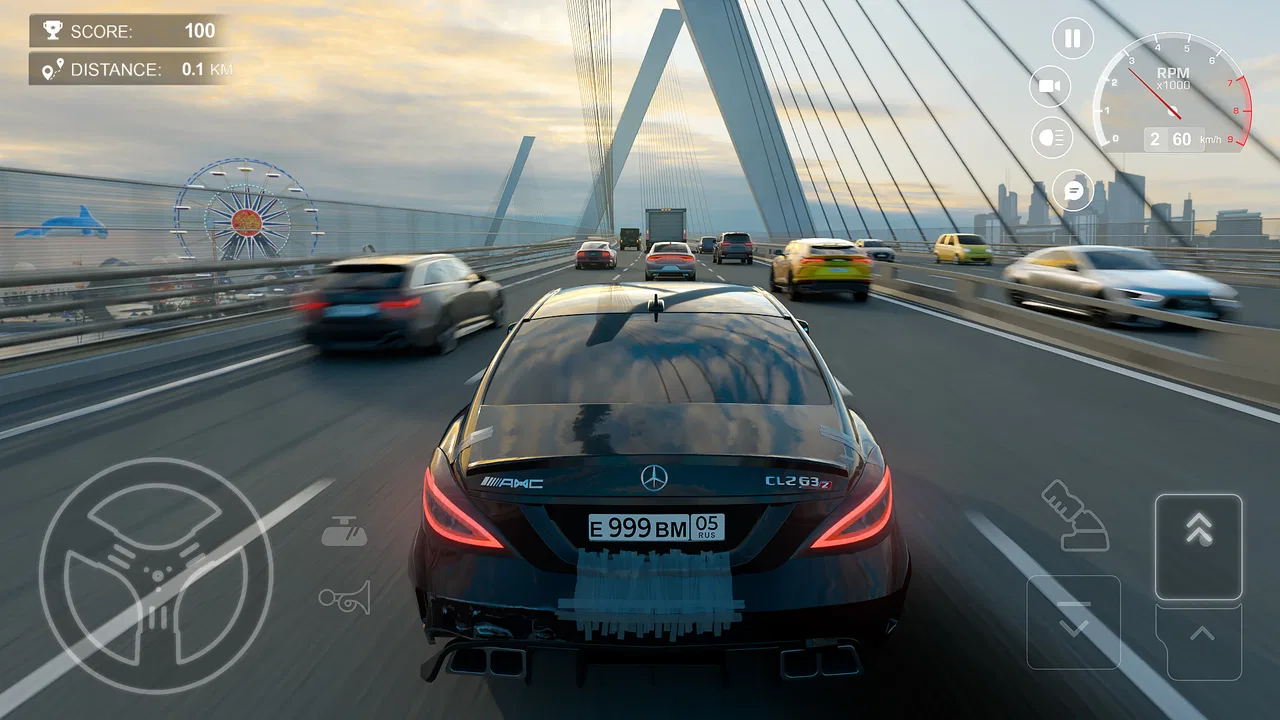
Traffic Racer Open World is the kind of racing game I open when I want immediate action rather than a long setup. I choose a car, enter the highway, and start threading through traffic while trying to stay alive and maintain a clean run. That simple first move explains much of its appeal: the game does not ask me to learn a complicated garage system before I can enjoy the driving.
Developed by TOJ GAMES LLC, it is free to download and aimed at Everyone. The game has built a sizeable audience, with more than ten million installs and an average score of 4.6 from roughly 263 thousand ratings. Those numbers suggest that the straightforward traffic-dodging formula connects with a lot of players, but my experience is that its appeal depends heavily on whether you enjoy repeating short, tense driving attempts.
How the driving loop feels from the first move
I find the first few moments useful for judging whether this driving loop suits me: rather than rushing into every opening, I watch how the traffic moves and make one deliberate lane change at a time. That small pause helps separate a control mistake from a risky decision. Once the rhythm feels familiar, the next question is how to prepare a device and session so the driving stays comfortable.
You May Also Like

 Blood Strike: 2.5 Anniversary
Blood Strike’s Loadouts Turn Every Drop Into a Tactical Gamble
A close look at Blood Strike’s custom loadouts: how fast access to signature weapons reshapes its battle royale rhythm, rewards preparation, and narrows the gap between fights.

 Pandora - Music & Podcasts
Pandora’s Music Is Easy to Start, but Harder to Recover
Pandora’s strength is its low-effort path from a seed to a station. Its weak spot is how much confidence it asks you to place in connection, setup, and quiet recovery.

 8 Ball Pool
 Is Built on Rivalries, Rematches, and Routine
A close look at the rivalries, rematches, shared routines, and unanswered safety questions that turn a quick pool match into a persistent mobile community.

 Samsung Music
’s Quiet Strength Is Playing What You Already Own
Its reach comes less from spectacle than from dependable access to a personal library. That simplicity is both the app’s strongest retention engine and its ceiling.

 AccuWeather: Weather Radar
AccuWeather Review: A Quick, Clear Forecast for Everyday Decisions
For everyday plans, the best forecast is the one you can understand quickly. AccuWeather makes rain timing, radar, and local conditions easy to act on, with a few trade-offs.

 Hill Climb Racing
Why Hill Climb Racing Still Turns Crashes Into One More Run
A tiny car, a bumpy hill and one more upgrade: Hill Climb Racing keeps resurfacing because its simple chaos makes every near-miss feel personal.
More From Our News Desk
View All News


The first action is deliberately uncomplicated
The opening appeal is easy to understand. I am placed on a road filled with moving vehicles, and my job is to find gaps, change position, and keep the car moving without turning a small mistake into a crash. There is no need to memorize a circuit or wait for a full race lobby before the main activity begins. The road itself creates the challenge.
That design makes the game useful in short bursts. If I have a few spare minutes, I can start a run quickly, concentrate on traffic, and stop after a failed attempt or a satisfying stretch of driving. It also makes the game approachable for someone who does not normally play serious racing titles. The controls and objective are easier to understand than a simulation that expects braking points, tuning knowledge, and track memorization.
At the same time, the open-road format changes the meaning of racing. I am not mainly trying to beat a rival to a finish line. I am managing risk in front of me. A clear lane invites speed, while a dense group of vehicles demands patience and better timing. That difference is important if you are deciding between this and a traditional lap-based racer.
Traffic becomes the opponent
The most interesting part of each attempt is reading the road a moment ahead. I have to notice which gaps are closing, decide whether a pass is worth the risk, and avoid making a sudden move simply because another lane looks faster. The best runs are not always the ones where I drive aggressively. Often, they come from choosing a safe line, then accelerating when the road opens again.
This creates a useful tension between speed and control. Driving cautiously can keep a run alive, but it can also make the session feel less exciting. Driving too boldly produces stronger moments, yet one poor decision can end the attempt. I like that the game makes this trade-off visible without requiring a complicated explanation. The road teaches it through immediate consequences.
A practical tip is to treat the first part of a run as a reading phase rather than a chance to prove how fast you can be. I watch the traffic flow, settle into the controls, and only then start taking narrower opportunities. This approach is especially helpful on a phone, where a small touch can create a larger movement than expected.
The feedback rhythm keeps the screen active
Traffic Racer Open World works because the feedback arrives quickly. I steer, see the car move, judge the next gap, and immediately discover whether that decision was good enough. There is very little distance between action and result. When I pass several vehicles cleanly, the run feels increasingly valuable; when I misjudge one gap, the reset is equally clear.
That rhythm is more important than the basic idea of avoiding cars. Many mobile racers offer similar traffic, but not all of them make every second feel like a decision. Here, the road repeatedly asks me to choose between a safer continuation and a more ambitious maneuver. Even when the scenery is not the main reason to play, the changing arrangement of vehicles gives each attempt a slightly different shape.
The feedback also helps new players improve without a formal lesson. A collision usually points back to a recognizable mistake: entering a gap too late, switching lanes without enough room, or assuming a vehicle will move differently than expected. After a few attempts, I naturally begin leaving more space and planning the next move earlier.
Why the reward is mostly the run itself
The strongest reward is the feeling of extending a run beyond the point where I expected to fail. A clean sequence of passes creates momentum, and that momentum makes the next decision feel more important. I may begin a session casually, but after surviving a difficult section, I want another attempt because I believe I can handle the same pressure more intelligently.
There is also a personal challenge in improving consistency. I am not only asking, “Can I drive quickly?” I am asking, “Can I make good choices for longer?” That distinction gives the game more staying power than a one-minute novelty. The reward is not limited to reaching a destination; it comes from building confidence in my timing and control.
Players should also understand the role of monetization before installing it. The game is free, while optional in-app purchases range from $0.99 to $69.99 per item. I would approach those purchases carefully and decide first whether the basic driving loop is enjoyable without spending. For me, the game earns its place through the road action, not through the assumption that buying something will automatically make the experience more satisfying.
The reset is part of the design
A failed run can be frustrating, but the restart is also what gives the game its repeatability. The attempt ends, I identify the moment where my judgment failed, and I immediately feel tempted to try again with a small adjustment. That is the classic action, feedback, reward, reset pattern, and this game keeps the cycle easy to understand.
The reset works best when I regard each attempt as practice rather than a final test. If I crashed because I moved too late, the next run gives me a chance to anticipate earlier. If I drove too aggressively, I can experiment with leaving a larger safety margin. This makes failure useful, provided I am in the mood for gradual improvement rather than a guaranteed win.
However, the same structure can become repetitive. The game is not ideal if you need a strong campaign, a deep narrative, or a large variety of objectives to maintain interest. Its motivation comes from repeating the road challenge and sharpening your decisions. Players who dislike restarting after a mistake may find the loop tiring sooner than fans of arcade racing.
Online and multiplayer expectations
The store summary presents the game as an online and multiplayer car racer, which makes it more attractive to players who want a social angle alongside solo driving. I would treat that as an important part of the game’s identity, but I would still choose it primarily for the immediate traffic challenge. The core reason to return is the driving loop: move, judge, survive, and try to extend the next run.
This matters when comparing it with other multiplayer racers. A conventional competitive racer usually focuses on direct contests, defined courses, and finishing positions. Traffic Racer Open World is more about handling a shared-feeling road environment and maintaining control through changing traffic. If you want a clear winner every few minutes, another racing game may suit you better. If you enjoy the pressure of weaving through vehicles and testing your reactions, this format is more natural.
Where it fits among mobile racing alternatives
Compared with a driving simulator, this game is easier to pick up and less demanding in its expectations. I do not need to approach it like a real driving lesson. The satisfaction comes from timing, lane choice, and staying composed when the road becomes crowded. That makes it a better casual option, though it may feel too light for someone looking for detailed vehicle behavior.
Compared with a kart racer, the mood is more focused on traffic flow than on playful weapons or exaggerated track design. The challenge is created by ordinary road hazards and my own decisions. Players who prefer bright arcade chaos may find it restrained, while players who like a simple test of concentration may appreciate the cleaner objective.
Compared with a track-based arcade racer, the open road gives the game more uncertainty. I cannot rely on learning every bend in advance because the immediate problem is the traffic in front of me. That makes each attempt feel reactive, but it also means the game offers less of the long-term satisfaction that comes from mastering a fixed circuit.
Small habits that improve a session
My first useful habit is to avoid treating every open space as an invitation to pass. A gap is only valuable if I can enter it and still have room for the next correction. I get better results by looking beyond the nearest vehicle and considering how the surrounding traffic will limit my escape route.
My second habit is to change pace mentally, even when the game encourages constant movement. A run feels safer when I alternate between observation and action instead of steering continuously. I use a clear section to prepare for the next cluster, then make one deliberate move rather than several nervous ones.
My third habit is to separate experimentation from score-chasing. When I am learning how the car responds, I accept that a run may end quickly. Once the controls feel familiar, I switch to conservative decisions and try to build a longer attempt. Mixing both goals at once can make a mistake feel more frustrating because I do not know whether I was practicing or trying to perform.
These habits are not advertised features, but they are where much of the game’s value appears. The title looks simple on the surface, yet it rewards players who manage attention rather than merely tapping quickly. That is also why the experience can feel surprisingly demanding during a short session.
Who should play and who should skip it
I would recommend it to someone who wants a free mobile racing game that starts quickly, works well in short sessions, and makes traffic avoidance the main source of tension. It is especially suitable for players who enjoy chasing a better personal run, learning from near misses, and repeating a challenge without needing a long story.
It is also a reasonable choice for a casual player who finds full racing simulations intimidating. The basic goal is obvious, and the road supplies the challenge without requiring a large amount of preparation. The Everyone content rating makes it broadly accessible as well, although individual comfort with fast-moving traffic and repeated crashes will still vary.
I would suggest skipping it if your priority is a structured career, extensive customization, realistic motorsport rules, or a deep progression system. It may also disappoint players who want every session to feel completely different. The game changes the traffic situation, but its central activity remains the same: drive through vehicles, protect the run, and restart after failure.
Device and version considerations
The game was released on July 7, 2022, and the current version is 0.6.7. It supports Android 7.0 and later, so many older compatible phones can at least meet the stated operating-system requirement. Before installing, I would still make sure the device has enough free space and that the screen responds reliably to quick steering input, because control precision matters more here than raw visual detail.
The app’s popularity is useful context rather than a guarantee. A high average rating and a large install base show that many players enjoy the formula, but they do not remove the central question: do you like repeating short traffic runs? I would make that decision based on the loop, not just the public score.
My verdict on the repeatable loop
Traffic Racer Open World succeeds when I want a direct test of timing. The first action is quick, the feedback is immediate, the reward is extending a clean run, and the reset gives me a clear reason to try again. That structure is simple, but it is not empty. It turns ordinary highway traffic into a sequence of small judgments that can become absorbing when I am trying to improve.
Its limitations are equally clear. The experience can become repetitive, it does not replace a full racing simulation, and players should think carefully about optional purchases rather than assuming they are necessary. Still, as a free racing game from TOJ GAMES LLC, Traffic Racer Open World offers a focused way to spend a few minutes or chase a longer, cleaner drive.
My recommendation is straightforward: install it if you enjoy arcade driving built around concentration, quick restarts, and personal improvement. I would choose a different game for a story-led career or detailed track competition. For everyone else, Traffic Racer Open World is worth trying because its central question remains effective: how long can you keep making the right move before the road finally catches you?
FAQs for Traffic Racer Open World
01What is Traffic Racer Open World?
Traffic Racer Open World is a driving game focused on cruising through expansive roads while weaving through traffic, completing challenges, and improving your vehicles. Unlike a traditional level-based racing title, it emphasizes free-roaming exploration and continuous driving. Players can usually enjoy different environments, traffic conditions, and driving objectives while working toward better cars, upgrades, and higher scores.
02Can I play Traffic Racer Open World offline?
The game may allow some driving and single-player features to work without a constant internet connection, which is useful when traveling or playing with limited data. However, certain functions can depend on online access, including advertisements, cloud-related services, updates, leaderboards, events, or other connected features. It is best to launch the game once while online and check which modes remain available offline.
03Is Traffic Racer Open World free to download and play?
Traffic Racer Open World is generally presented as a free-to-download game, but free access may include advertising and optional in-app purchases. These purchases can potentially provide currency, vehicles, upgrades, or other conveniences, depending on the current version. You can normally progress without paying, although unlocking content or improving cars may take longer if you do not spend money.
04What devices are compatible with Traffic Racer Open World?
Compatibility depends on the version available for Android or iOS, as well as the operating system requirements listed on the official store page. Because the game includes 3D environments, traffic, and real-time driving, older phones may experience reduced graphics quality, slower loading, or occasional performance issues. Check the download page before installing and ensure you have enough free storage.
05Does Traffic Racer Open World require an internet connection or account?
An account is not always required for basic gameplay, but this can vary according to the platform and the features included in the installed release. Internet access may be needed for the first download, updates, advertisements, purchases, rankings, or synchronized progress. Before starting, review the permissions and sign-in prompts so you understand what information the game requests and which features depend on connectivity.
Pros
- Large open-world map offers more freedom than traditional lane-based racers.
- Simple controls make driving easy to learn on both phones and tablets.
- Many vehicles provide different handling styles and performance options.
- Traffic density creates varied challenges during longer driving sessions.
- Works well for quick races when you only have a few minutes to play.
Cons
- Frequent traffic collisions can feel frustrating during crowded runs.
- Vehicle upgrades may require considerable time or repeated gameplay.
- Visual quality can vary noticeably across different devices.
- The open-world environment may feel repetitive after extended play.
- Ads or optional purchases may interrupt the overall racing experience.

Traffic Racer Open World
Gallery